We have a specialized technical department dedicated to accompanying you through all stages of planning and execution of your projects.
- Load Analysis.
- Transformer Calculations.
- Safety Clearances.
- Voltage Drop Calculations.
- Energy Loss Calculations.
- Short-Circuit and Ground Fault Analysis.
- Protection Sizing and Coordination.
- Grounding System Calculations.
- Single-Line Diagrams.
- Electrical Construction Drawings.
Construction Features:
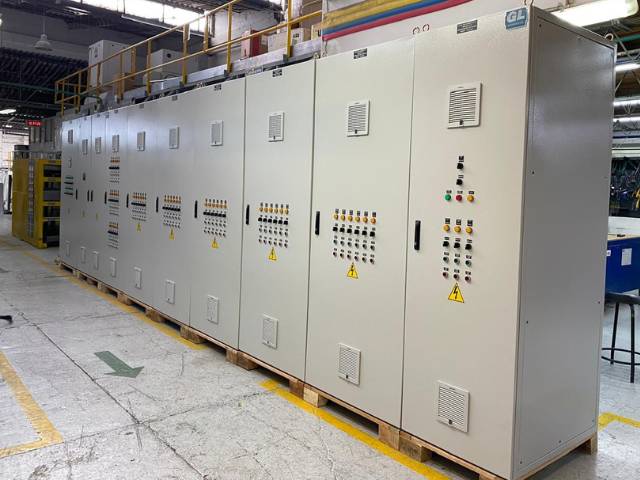
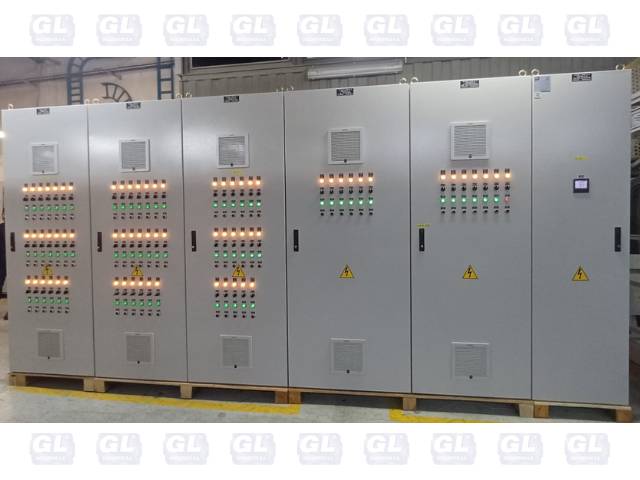
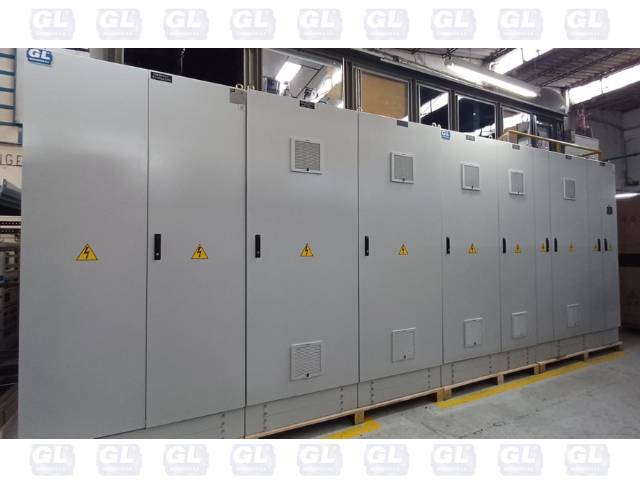
Construction in Cold Rolled, Galvanized, or Stainless Steel sheet metal of various gauges according to customer needs and/or applicable standards.
- Sheet metal surface treatment through degreasing, rinsing, phosphating, rinsing, and passivating. Performed in 5 stages.
- Textured bake-on electrostatic powder coating, color RAL 7030-7032-7035.
- Triangular socket key locks or two-slot double-bit cylinder locks with three-point locking mechanisms.
- Covers are fixed to the body with countersunk tropicalized or iridescent Bristol hardware, externally removable.
- The hardware used (Nuts, washers, flat washers, etc.) is Grade 5 and 8 Tropicalized Iron.
- The mounting type can be FREESTANDING, SURFACE-MOUNTED, OR FLUSH-MOUNTED. According to specifications.
- Cabinets feature identification plates and internal pockets for manufacturing drawing management.
- Panels are designed in accordance with customer requirements, equipment, and industry standards.
Construction Standards:
- RETIE Technical Regulation for Electrical Installations.
- NTC 2050 Colombian Electrical Code.
- NTC 3475 Electrotechnics, Electrical Panels.
- NTC 3278 Low-Voltage Switchgear and Controlgear Assemblies, Type-Tested and Partially Type-Tested Assemblies.
- NTC – IEC 60439 Factory Built Assemblies of Low Voltage Switchgear and Controlgear.
- NEMA ICS 1 General Standards for Industrial Control and Systems.
- NEMA ICS 2 Standards for Industrial Control Devices, Controllers and Assemblies.
- ANSI C37.20 Switchgear Assemblies Including Metal-Enclosed Bus.
- IEC 60529 Degrees of Protection Provided by Enclosures (IP Code).
- IEEE 519 IEEE Recommended Practice and Requirements for Harmonic Control in Electric Power Systems.
For the manufacturing of our electrical panels, we use the following form factors:
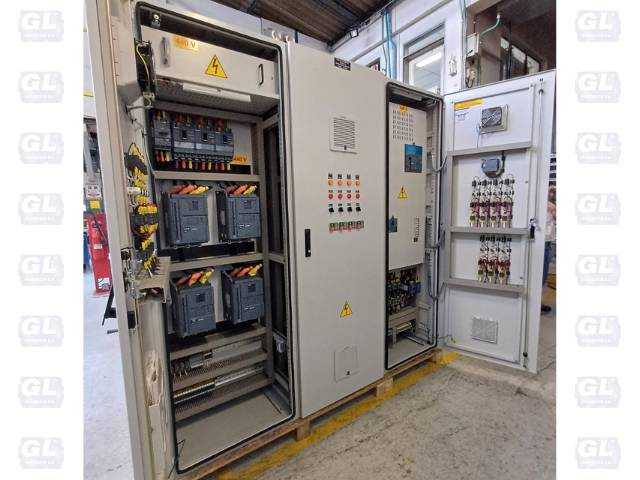
- Form 1. Used in compact panels where there is no separation between equipment, busbars, and output terminals.
- Form 2a. Separation is provided between equipment and busbars; output terminals are located in the busbar compartment.
- Form 2b. Separation is provided between equipment and busbars; output terminals are located in the equipment compartment.
- Form 3a. Individual separation is provided for each piece of equipment, but busbars and output terminals are located in the same compartment.
- Form 3b. Individual separation is provided for each piece of equipment, but busbars and output terminals are located in separate compartments.
- Form 4a. Equipment is separated individually, but output terminals are in the same compartment as the equipment; the busbar is in a separate compartment.
- Form 4b. Everything is located in independent and individual compartments: one compartment for the busbar, one compartment for each piece of equipment, and one compartment for each output terminal.
TESTING
Our panels are factory tested according to standard IEC 61439 Section 10 "Routine tests" and laboratory tested according to Section 11 "Verification tests".
ROUTINE TESTS
- Panel inspection and electrical operation test.
- Dielectric test.
- Clearance and creepage distances.
- Insulation resistance.
- Validation of IP and IK degree of protection.
- Mechanical operation.
VERIFICATION TESTS
- Temperature-rise limits.
- Dielectric properties.
- Short-circuit withstand strength.
- Clearances and creepage distances.
- Mechanical operation.
- IP and IK degree of protection.
- Protection against electric shock.
- Electromagnetic compatibility.
*Tests performed in national and international laboratories.
We have tools for the analysis and design of our projects.
3D DESIGN SOFTWARE:
Specialized design software that allows 3D visualization of our products and services, such as: panels, electrical substations, service lines, cable tray and conduit routes with power and control wiring in industrial assemblies, for client review and validation. The great advantage offered by this type of development is that, thanks to its real-scale creation, the design can be modified without incurring rework overcosts during project execution.
ELECTRICAL DESIGN SOFTWARE:
Software dedicated to electrical schematic design, managing an extensive symbol library, facilitating and standardizing designs, generating equipment product lists and connection schedules, and exporting/importing to and from other software through a simple graphical interface.


 EN
 ES